

By Nils A. Shapiro
It would be evident to anyone who browsed through the approximately 500 books in my home office library, or is a regular reader of the more than 200 review columns that have been published in this newspaper over the past 20 years, that history—and American history in particular—is of special interest to me.
So some readers might well wonder why it is that I have devoted fewer of my review columns to the works of such authors as Jon Meacham, Doris Kearns Goodwin, Ron Chernow, Alan Taylor and David McCulloch—which consistently appear at the top of our national bestseller lists—and yet I have in recent years introduced my readers to the four most recent of author/historian Howard Mansfield’s twelve previously published books:
- Summer Over Autumn: A Small Book About Small-Town Life (2017)
- The Habit of Turning the World Upside Down (2018)
- Chasing Eden: A Book of Seekers (2021)
- I Will Tell No War Stories: What Our Fathers Left Unsaid About World War II (2024)
By way of introduction to this author for those still unfamiliar with his work I first offer the following few examples of others’ comments:
“As an excavator and guardian of our living past, Howard Mansfield is unmatched. This decent, unpretentious, wonderful writer possesses the sensibility of a poet combined with boundless curiosity and deep, deep knowledge.” – John Heilpern, Vanity Fair
“Howard Mansfield has never written an uninteresting or dull sentence. All of his books are emotionally and intellectually nourishing. He is something like a cultural psychologist along with being a first-class cultural historian. He is humane, witty, bright-minded, and rigorously intelligent…” – Guy Davenport, author of The Death of Picasso
“Like Thoreau, Mr. Mansfield is a keen observer …” – The Wall Street Journal
“He writes with wit and passion; he has an eye for the luminous details and wears his learning lightly. …” – Utne Reader
And now it is my turn, before I describe Howard Mansfield’s newest book that is being published this month, to describe what it is about his work that I find so deeply affecting and why, after I turn the last page of each of his books I sit quietly for some time savoring two distinct feelings: impressed by this author’s remarkably creative and original approach to history … and personal satisfaction for my own willingness to take that previously untrodden journey with him and been rewarded for it.
One example of such reward will perhaps explain: George Washington justly deserves our nation’s gratitude for voluntarily stepping down after his two terms as president despite the people’s desire for him to continue in the White House. He did so because, as he pointed out, the nation had fought its revolution in order to rid itself of a king and it was important to set an example that no man should hold the power of the presidency so long as to begin to consider himself a king.
In his book, The Habit of Turning the World Upside Down,—the theme of which focuses on the American people’s passion to own property, in most cases for the first time, following the revolution—Howard Mansfield informs us that after leaving the White House George Washington went into the real estate business. He wanted to purchase some land along a river. The law restricted the amount of riverfront land that any one individual could purchase and own, so Washington contacted family and friends and arranged to lend them the money for each to purchase riverfront land in his or her own name. Afterward, they all “sold” their land to Washington, who as a result ended up illegally owning most of the riverfront property.
This is not the image we have of George Washington, a bit of history I had never known in all my years of schooling through college and decades of reading since then. It is a testament to the extraordinary depth of research Mansfield devotes to each of his books, with the result that every page offers compelling facts very few readers will have previously known.
When most of us think of monuments we first envision such structures as the Lincoln Memorial, Washington Monument, Jefferson Memorial, often statues of men on horseback, then think further to include Arlington Cemetery and other like sites where we honor those whom we remember – generally for their service to our nation.
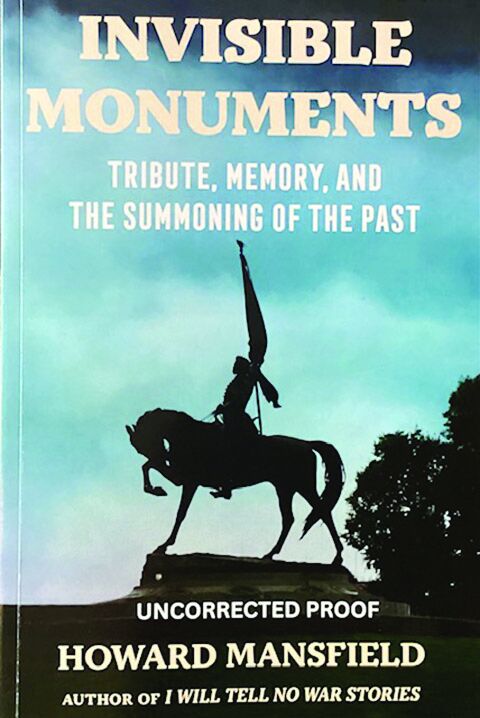
Howard Mansfield defines the word and purpose of “monument” somewhat differently, and in his new book, Invisible Monuments, tells the engaging and often emotional stories behind eight monuments—all of which will be completely unknown to almost all of the readers of this review column.
Among them:
- The unmarked graves of many hundreds of Irish immigrants from neighboring counties in Ireland who hated each other and brought their war from the old country with them when they came to the U.S. during the Great Famine in Ireland of the early to mid-1800s, settled in the New England states and worked laying tracks for the new railroad.
- A Ferris Wheel that has been standing still in New York for decades, rusted now, as a memorial to the death of a five-year-old boy.
- A grieving American farm family’s memorial to a son lost in World War II, the “Cathedral in the Pines” continues to draw thousands of visitors a year.
- From the Cenoptaph—the empty tomb set on the route of the London Peace Day Parade in July 1919 celebrating the end of World War I—to the Vietnam Veterans’ Memorial in Washington, to the Monument Against Fascism built by the city council in Hamburg, Germany in 1986, Mansfield describes the projects, purposes and design efforts.
- Perhaps most astonishing of all is a monument that does not look to the past like other monuments. Instead, it is intended as a tribute to the future: a clock that is actually being built deep in a mountain in West Texas, in a shaft 500 feet deep – a clock that is meant to run for 10,000 years! Billionaire Jeff Bezos, the founder of Amazon.com, contributed $42 million to the concept and the author describes this entire little-known, but already begun, project in significant detail in these pages.
As the author writes, “The clock is a technological sleight of hand, but even more so, it is a virtuoso act of optimism. The conjurers of this clock want us to believe that another 10,000 years of civilization is possible.”
Once again, as with Howard Mansfield’s earlier four books that I have reviewed in this column, I turned the last page of Invisible Monuments with the satisfaction that I had been in the company of a “thinking reader’s” author. A good feeling.